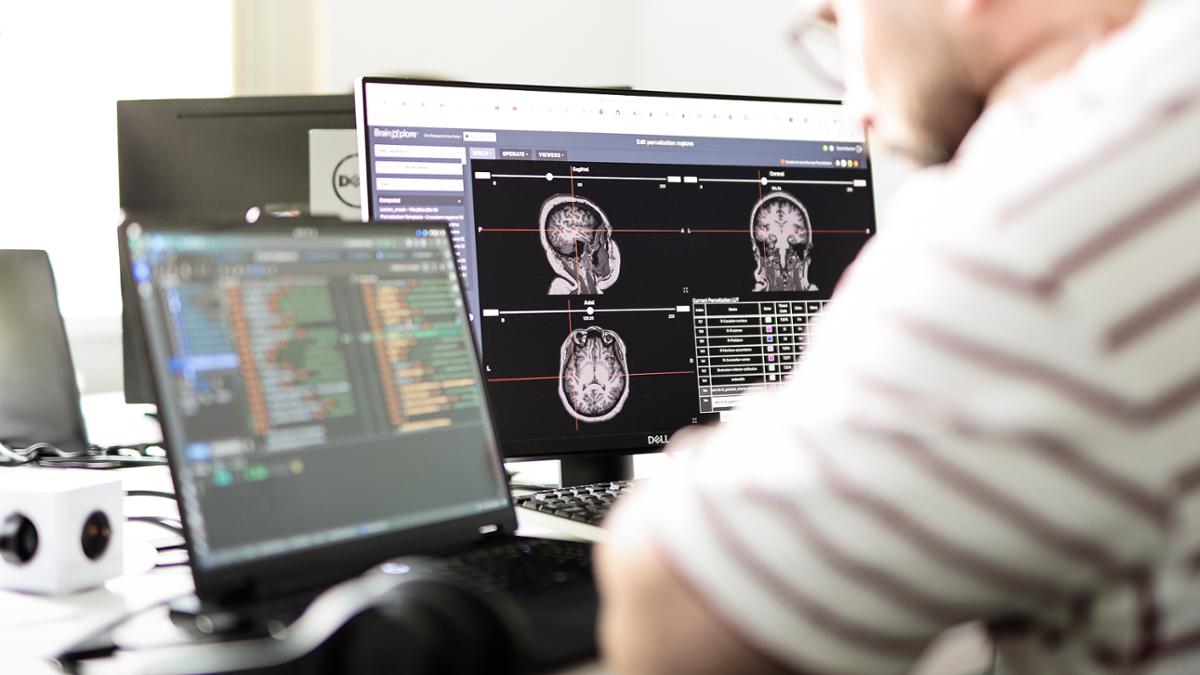
Codemart science developers will participate in the EBRAINS Virtual Users' Week as tutors – demonstrating how complex computational workflows can be represented as connected components, making them easier to understand, configure, and reuse.
Lia and Paula from our Brainiacs team will guide participants through practical use cases for our Xircuits extensions for The Virtual Brain (TVB), running in the EBRAINS JupyterLab.
Register until October 8: it's free but requires an EBRAINS account.
Our workshop will be held at two different timezone slots on October 14.
Tutorial program
This workshop introduces tvb-ext-xircuits, a JupyterLab extension that enables users to visually create and execute workflows based on The Virtual Brain (TVB) and related tools within the EBRAINS Lab environment.
The first part of the workshop will provide a short introduction to key TVB concepts, such as brain connectivity, models, simulations, and their main building blocks, to give participants the necessary context before exploring the xircuits extension.
Participants will explore existing workflows for running TVB simulations and Virtual Brain Inference (VBI) workflows using a visual, component-based interface. The workshop will demonstrate how complex computational workflows can be represented as connected components, making them easier to understand, configure, and reuse.
Participants will also be introduced to the possibility of extending these workflows by creating new Xircuits components directly within EBRAINS Lab.
Target group of the workshop
The workshop is intended for beginner to intermediate users, who are interested in computational neuroscience and brain modelling.
Expected learning outcomes
By the end of the workshop, participants will be able to:
understand the purpose of tvb-ext-xircuits and how it integrates with EBRAINS Lab;
understand how a computational workflow can be represented visually usinginterconnected components;
explore and execute existing Xircuits workflows based on TVB and VBI;modify workflow parameters and understand how information is passed between components;
understand how Xircuits workflows can be extended with new components;create a simple custom Xircuits component directly within EBRAINS Lab and use it in a workflow.
Preparations
Participants do not need to install software locally, as the workshop will be carried out entirely within EBRAINS Lab.
For the workshop, participants should:
have an active EBRAINS account;
make sure they can access EBRAINS Lab;
have attended, or be familiar with the basic concepts presented in the preceding introductory workshop on The Virtual Brain.
No advanced programming preparation is required. Basic familiarity with Python may be helpful for the component-creation exercise, but the necessary concepts will be explained during the session.